Tension Headaches and Migraines: Can Massage Therapy Help?
You know that feeling. A tight band around your forehead. Your neck feels like it's holding up something way too heavy. The pain creeps up the back of your skull and settles right where your head meets your shoulders. Sometimes it's a dull ache. Sometimes it's a vice grip that makes you want to just lie down.
Tension headaches are the most common type of headache, affecting somewhere between 46 and 78 percent of people at some point in their lives. That's not surprising when you think about how we actually live — stress, desk work, phones, hunched shoulders, irregular sleep. Our nervous systems are basically on high alert, and our muscles pay the price.
The question you're probably here asking is simple: Can massage actually help?
The answer is yes. And I'm not just saying that because I'm a massage therapist. The research backs it up. If you're ready to explore how hands-on therapeutic work can address this, you can book a session here.
What's Actually Happening When You Have a Tension Headache
Most tension headaches aren't random. They come from somewhere. Usually it's your muscles.
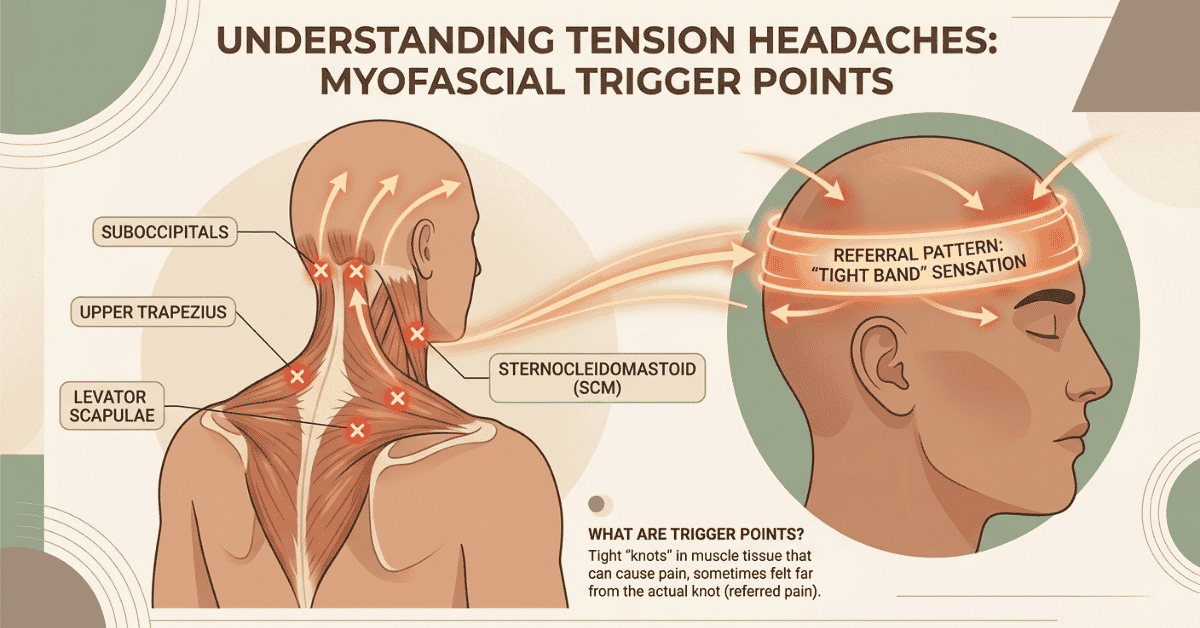
When you're stressed or you're hunched over a keyboard for eight hours, certain muscles in your neck, shoulders, and scalp tighten up. The suboccipitals (those tiny muscles at the base of your skull), your upper trapezius, your levator scapulae, and your sternocleidomastoid all start to shorten and tighten. Your body is literally bracing itself.
These muscles contain what we call myofascial trigger points — little knots where the muscle fibers have gotten stuck in a shortened state. These trigger points don't just feel bad locally. They refer pain. A trigger point in your upper trap can send pain up the side of your head. Suboccipital trigger points can create that classic "band around the forehead" sensation.
This is exactly what research shows happens. And it's also exactly what myofascial release can address. I've written before about what myofascial release actually feels like, and for tension headaches specifically, it's one of the most effective approaches.
What the Research Actually Shows
Let me be clear about what I'm pulling here. This isn't anecdotal. Multiple clinical trials and systematic reviews have looked at whether massage therapy works for tension-type headaches.
A 2021 systematic review published in Cureus* analyzed eight clinical studies involving 3,846 participants. The findings were straightforward: both manual therapy and acupuncture showed significant reductions in headache symptoms. But here's what's notable — manual therapy was not inferior to prophylactic medication and tricyclic antidepressants (which are commonly prescribed for chronic tension headaches). In other words, massage was as effective as drugs that people take daily to prevent headaches.
Even more specific is a 2024 systematic review and meta-analysis** looking directly at myofascial release for tension-type headaches. The pooled results showed that myofascial release intervention significantly reduced pain intensity and improved disability in both tension-type headaches and cervicogenic headaches (headaches coming from your neck). For tension-type specifically, the pain reduction was statistically significant, and disability improved as well.
The mechanism is real too. A 2015 randomized controlled trial from the Clinical Journal of Pain*** examined trigger point-focused massage specifically. Patients with recurrent tension headaches received twelve massage sessions over six weeks targeting trigger points in the cervical (neck) musculature. The results showed that patients who received the massage reported greater perceived clinical improvement in headache pain compared to both placebo and wait-list controls. Even better, pressure-pain threshold improved in the upper trapezius and suboccipital muscles — meaning those muscles became less sensitized and more resilient.
What I'm telling you is this: the tight muscles in your neck and shoulders that are causing your headaches respond to manual therapy. And when you address the source of the tension, the headaches improve.
Why Typical Treatments Miss the Point
Most people with tension headaches reach for ibuprofen or aspirin. Some go to a doctor and get prescribed preventative medication. Both approaches treat the symptom, not the cause.
Medication quiets down pain signals. That's helpful when you need relief right now. But it doesn't address why your muscles are tight in the first place. It doesn't release the trigger points. It doesn't improve your posture or how your nervous system handles stress.
That's where massage comes in differently. I'm not just working on "relaxation" (though that happens). I'm identifying exactly where the tension is, where the trigger points are, and I'm applying sustained pressure and movement to release them. Once those muscles aren't sending pain signals to your head anymore, you don't need the medication in the first place.
If you're curious about how this actually works in a session, read about what to expect from your first in-home massage. The process is straightforward, and I tailor everything to what your body needs.
What a Session Actually Looks Like
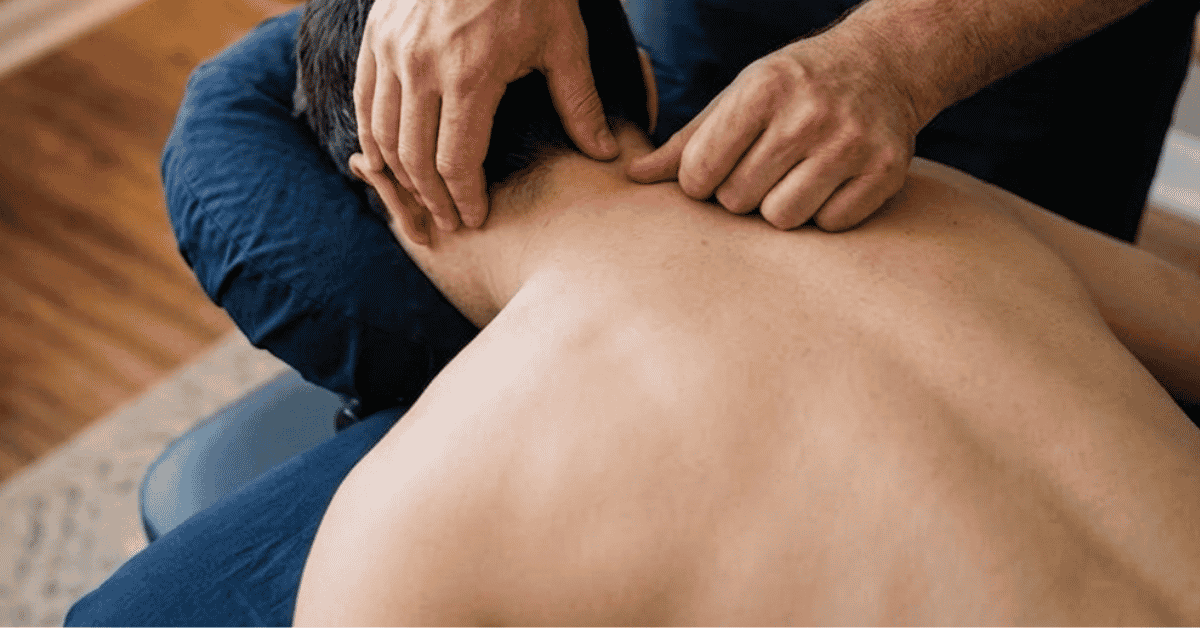
When someone comes to me with tension headaches, we start with an intake. I ask about where the pain is, what makes it worse, how long you've had it. I'll feel your neck, shoulders, and the muscles at the base of your skull. I can usually find the problem spots pretty quickly — they're tight, they're sensitive, and often touching them recreates at least part of the headache you've been feeling.
Here's what matters: I'm not doing generic relaxation massage. I'm doing targeted, therapeutic work. I'm using sustained pressure on trigger points. I'm applying myofascial release technique. I'm working your suboccipitals, your upper traps, your levator scap, the muscles along the base of your skull. I'm also looking at your shoulders and upper back, because tension there absolutely contributes to what's happening in your neck and head.
The work isn't always comfortable. Trigger point work can be intense. But it's the kind of intensity that feels like it's actually fixing something — not the dull ache of just being relaxed.
I bring my table, my sheets, my oil, and the expertise I've built over nearly a decade of working with people in Los Angeles dealing with exactly this problem. And I come to your home in Beverly Hills, Santa Monica, West Hollywood, Studio City, Encino, Calabasas, Hollywood, and throughout the Valley, so you're comfortable in your own space without the stress of driving to an appointment or rushing out afterward.
How Often Do You Need This
One session helps. It releases tension, improves pain, and gives you some relief. But tension headaches are chronic for most people because the stressors that caused them are ongoing. Your job is still stressful. You're still at a desk. Your nervous system is still reacting to the pace of LA.
What works is regular sessions. I typically recommend monthly maintenance for people with chronic tension headaches once we've done the initial work. Some people benefit from every two weeks. Think of it like this: you didn't develop these tight muscles overnight, so you're not going to permanently fix them in one session. But with consistent work, the muscles stay released, the trigger points stay quiet, and you can actually live without constant headache pain.
This is similar to what I've found with other chronic pain conditions. If you've dealt with lower back pain, you know that consistency is key to lasting relief.
Between sessions, there are things you can do. Stretching helps. Breathing exercises help. Getting your neck away from looking down at your phone helps. But if the underlying muscle tension is there, those things are just managing the symptom.
Ready to get started? Book your first session and we'll create a plan that actually addresses what's causing your headaches.
The Real Question
You're probably wondering if this is actually worth your time and money. Fair question.
Here's what I know: tension headaches steal time. They steal focus. They make you irritable. They make you reach for medication you wouldn't need if the muscles weren't tight. If you've been dealing with this for months or years, you've already spent money on over-the-counter pain relievers, doctor visits, maybe even prescription medication. You've lost work productivity. You've had days where you just felt lousy.
The research shows that massage addresses the actual problem. It works as well as preventative medications, but it doesn't carry the side effects of daily drugs. And unlike medication, it actually improves the resilience of your muscles rather than just masking pain signals.
I work with people throughout the greater Los Angeles area. I travel to you. You don't have to take time out of your day to drive to an appointment. You can get the session done in your own home and actually rest afterward instead of sitting in LA traffic.
For the past decade, I've built a practice around solving the hard problems — the ones that don't respond to generic massage or medication. Tension headaches are often rooted in trigger points and fascial restrictions that require skill to identify and release. That's exactly what I do.
If tension headaches have been part of your life, it's worth exploring whether hands-on therapeutic work can change that. Because it can.
Schedule your in-home massage session here and let's get started.
References
Turkistani A, Shah A, Jose AM, et al. Effectiveness of Manual Therapy and Acupuncture in Tension-Type Headache: A Systematic Review. Cureus. 2021;13(8):e17601. https://doi.org/10.7759/cureus.17601
** Lu Z, Zou H, Zhao P, Wang J, Wang R. Myofascial Release for the Treatment of Tension-Type, Cervicogenic Headache or Migraine: A Systematic Review and Meta-Analysis. Pain Res Manag. 2024;2024:2042069. https://doi.org/10.1155/2024/2042069
*** Moraska AF, Stenerson L, Butryn N, et al. Myofascial trigger point-focused head and neck massage for recurrent tension-type headache: a randomized, placebo-controlled clinical trial. Clin J Pain. 2015;31(2):159-168. https://doi.org/10.1097/AJP.0000000000000091